Bahrain – UN Experts’ statement on the Trial of 69 Shia Clerics in Bahrain exposes catastrophic failures in the administration of justice
Government of Bahrain must take concrete action to end miscarriages of justice
SALAM for Democracy and Human Rights welcomes and supports the contents of the statement issued by United Nations experts on 20 November 2026. The statement issued by six United Nations independent human rights experts, entitled Bahrain: UN experts alarmed by torture allegations and due process concerns in mass trial of Shia clerics, sets out a catalogue of failures in Bahrain’s administration of justice and reinforces concerns raised by international and Bahraini human rights organisations regarding the trial’s failure to meet international fair trial standards, suggesting too that flaws are systemic.
Salam for Democracy and Human Rights (SALAM DHR) condemns this miscarriage of justice and renews its call on the Bahraini authorities to release all detainees unless they are to be charged with an internationally recognisable criminal offence, conducted under international fair trial standards.
Lawyers for the 69 religious professionals are expected to submit an appeal in the coming days.
The entire government, by way of its collective responsibility, and the Minister of Justice, Nawaf bin Mohammed al-Mawadah, responsible for the oversight of the trial, is accountable for this catastrophic failure of justice: he must resign over this, most recent failure in Bahrain’s justice system.
The statement reportedly made on 25 November 2026, by the King of Bahrain’s Cultural and Scientific Affairs Advisor, Hala bint Mohammed Jaber al-Ansari, that the six human rights experts’ assessment “[R]eflects a double standard,” citing “a striking similarity between the language used by these experts and the rhetoric employed by Iran […]” denigrates the experts’ assessment. The internationally recognised human rights experts set out their assessments in good faith and conscience; the advisor’s statement further denigrates and distances Bahrain’s commitment to international human rights standards and the UN human rights system itself.
The government of Bahrain must distance itself from the comments made by the advisor and set out the concrete steps it will take to address the genuine and real concerns that the statement reflects.
The UN experts echoed Bahraini activists and organisations’ findings that “confessions” used as the partial or complete basis for conviction resulted from officials’ torture of the accused. This alone invalidates the integrity of the judicial proceedings: such “confessions” must not be relied upon to establish guilt, except when used as evidence against those responsible for torture, in accordance with Article 15 of the Convention against Torture.
In paragraph 55 of its 19 January 2026 Concluding Observations on the Government of Bahrain’s 2025 report on its implementation of the Convention against Torture, the United Nations’ Committee against Torture set a 28 November 2026 deadline to inform the Committee of the government’s plans in relation to recommendations made concerning incommunicado detention in unofficial places, conditions of detention, monitoring of detention facilities and deaths in custody.
Insofar as the religious professionals convicted on 16 November reportedly, directly or indirectly, faced each of these in the course of their pre-trial detention, the Government of Bahrain signals that it knowingly chooses to operate outside the framework of international law and does so with impunity.
Background
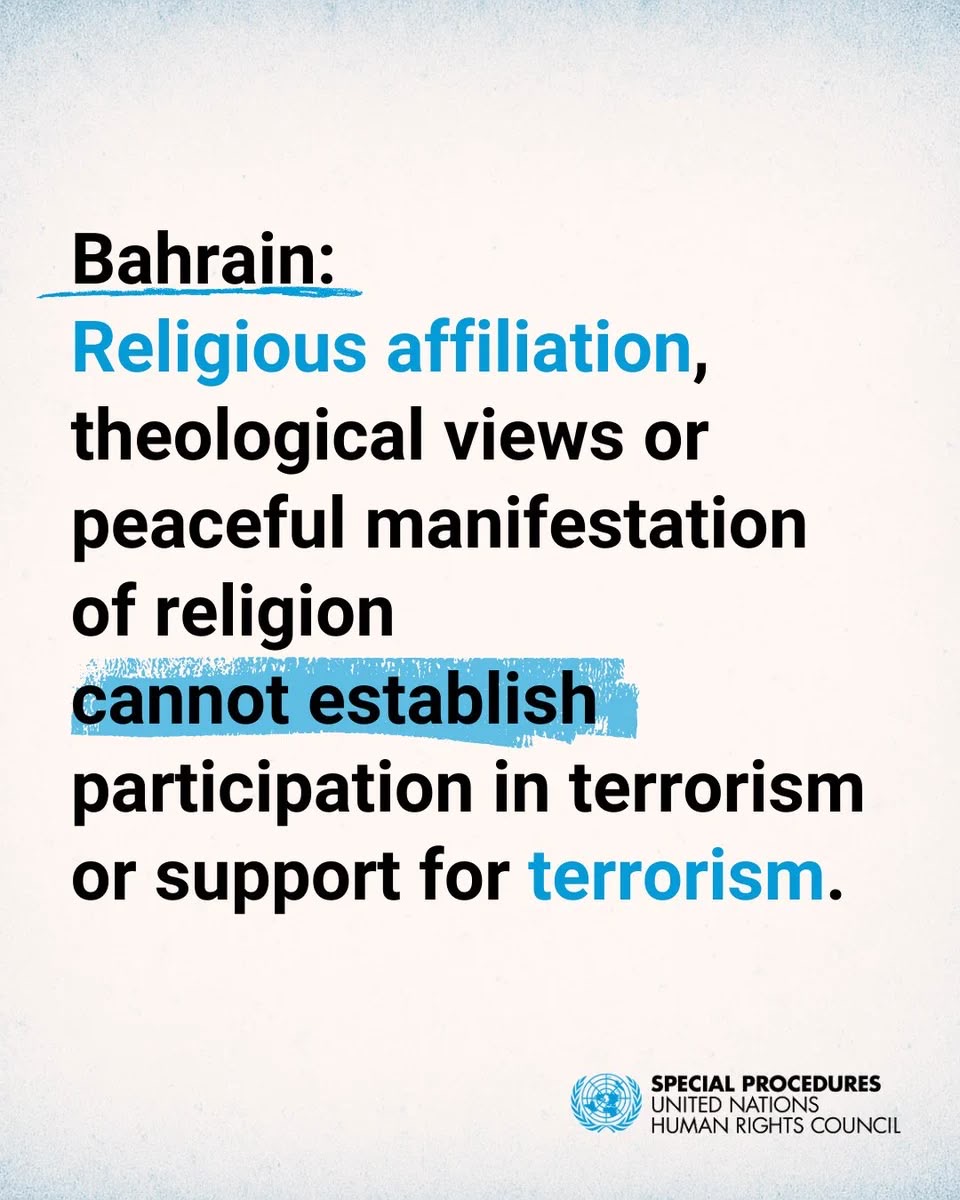
The six experts’ statement highlights the inconsistency between international fair trial procedures and the government’s criminalisation of peaceful religious practices and rituals associated with Shiism, viz., the treatment of religious activities, rituals and financial contributions of a religious nature, including socio-religious links with co-religionists outside Bahrain, as evidence of the commission of terrorist offences, constituting a restriction to the right to freedom of thought, conscience and religion, guaranteed under Article 18 of the International Covenant on Civil and Political Rights (ICCPR), to which Bahrain is a state party.1 The court relied on, inter alia, financial contributions of a religious nature, including the religious obligation of khums, and used them in the context of counterterrorism-related charges.
The court framed religious practices, expressions of faith and associated financial contributions – the religious obligation of khums – as expressly criminal in character, but failed to establish a clear and direct material connection to acts criminalised by law or the consequence of the alleged acts. The Minister of Justice oversaw, accordingly, the negation of the principle of legality in criminal law and the requirement for specific, individualised evidence establishing the criminal responsibility of each defendant: he has opened the door to discrimination and sectarian persecution being codified into Bahraini law.
Over the past fifteen years, the Bahraini authorities have repeatedly used a range of security-related and political charges, such as incitement to hatred, attempting to overthrow the regime, membership in terrorist groups and the commission of “terrorist” acts, to prosecute non-violent critics and opponents. These practices are particularly concerning when analogous charges are repeatedly brought against specific persons and/or groups whose sectarian characteristics or political positions overlap.
The recurrence of such charges in different political and human rights contexts, and the targeting of individuals on the basis of their sectarian affiliation or their exercise of the rights to freedom of expression and peaceful assembly, constitutes the express targeting of a community with a distinct set of beliefs, even if that community may form a subset in a larger community. It constitutes religious persecution.
In his 8 January 2026 report, Defining terrorism to respect and protect human rights, the Special Rapporteur on the promotion and protection of human rights and fundamental freedoms while countering terrorism, Ben Saul, condemned states for exploiting overly broad terrorism and national security laws to criminalise peaceful dissent, restrict civic space, and erode fair trial guarantees. He set out how governments weaponise counter-terrorism charges against peaceful critics and members of civil society. To prevent such abuses, the Special Rapporteur introduced a strict model definition in 2026, insisting that terrorism offences apply solely to intentional acts of lethal or serious physical violence.2
On account of the disparity, indeed, outright disconnect between at least many of the alleged acts, lack of objectively verifiable evidence and sentence meted out, SALAM DHR expresses concern over the Bahraini government’s weaponisation of regional conflict in order to reframe fundamental rights and freedoms as matters of regional security, thus in effect seeking to delegitimise criticism, media coverage or accountability for human rights violations.
SALAM DHR urges the Government of Bahrain to engage in good faith with the UN’s human rights mechanisms, including by inviting Special Rapporteurs on the independence of judges and lawyers and on freedom of religion or belief, to Bahrain, in order that they undertake an unfettered assessment of policy and practice, including the administration of justice.
Notes
- UN / International Covenant on Civil and Political Rights, 1966, at: https://www.ohchr.org/en/instruments-mechanisms/instruments/international-covenant-civil-and-political-rights, accessed 25 November 2026. Article 18 states that (1) Everyone shall have the right to freedom of thought, conscience and religion. This right shall include freedom to have or to adopt a religion or belief of his choice, and freedom, either individually or in community with others and in public or private, to manifest his religion or belief in worship, observance, practice and teaching. (2) No one shall be subject to coercion which would impair his freedom to have or to adopt a religion or belief of his choice. (3)Freedom to manifest one’s religion or beliefs may be subject only to such limitations as are prescribed by law and are necessary to protect public safety, order, health, or morals or the fundamental rights and freedoms of others. ↩
- UN / OHCHR – Special Rapporteur on the promotion and protection of human rights and fundamental freedoms while countering terrorism, Ben Saul: Defining terrorism to respect and protect human rights, 8 January 2026 (UN reference A/HRC/61/52), at https://www.ohchr.org/en/documents/thematic-reports/ahrc6152-defining-terrorism-respect-and-protect-human-rights, accessed 25 November 2026 ↩
Take action: Share this statement to help keep international attention on the 69 clerics and religious workers convicted in Bahrain. Read our earlier statement on the unfair trial of 69 clerics. If you have information about torture, arbitrary detention or unfair trials in Bahrain, you can report a violation to SALAM DHR in confidence, or contact our team. Our publications library holds our full reports on human rights in Bahrain.